WritingEssay·10 sections · 18 figures
The Lattice and the Light
A chameleon's colour isn't borrowed from the leaf it sits on. It comes from the spacing of crystals under its skin, which turns out to be a good way to think about ambition and the rooms that hand it to you.

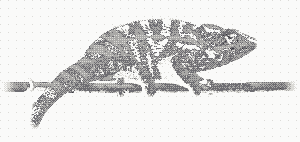
Walk into a forest in Madagascar after dark with a headlamp, and something strange happens.
Chameleons are hard to spot by day. At night they are easy. Asleep at the tips of branches, their skin goes pale, almost luminous, and they catch your beam like small lanterns hung in the leaves.
The strange part comes if you keep the light on one.
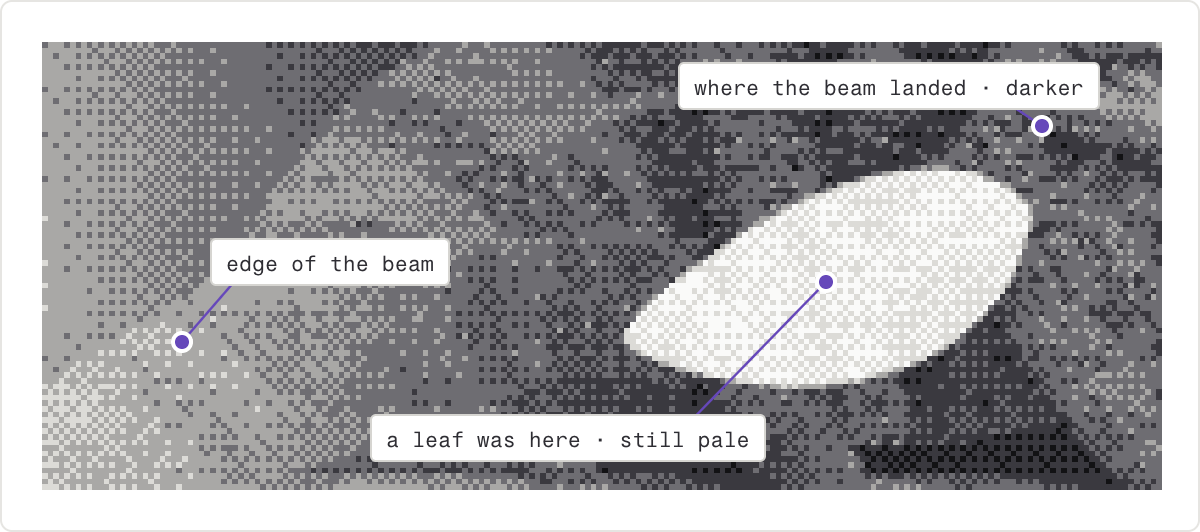
Mark Scherz4, who studies chameleons in Madagascar, describes how the lit side of a sleeping chameleon starts to darken within seconds while the far side stays pale. If a leaf is lying across its body, the skin under the leaf stays light and everything around it goes dark.
Lift the leaf, and its silhouette is printed on the animal.
I keep coming back to that picture. The light leaves a mark, and so does the shadow. The patch that never caught the beam is as much a part of the pattern as the part that did.
It made me think about something I can't stop turning over: how much of who we become is set by the rooms we happen to end up in, and how much of what we call our limits is just the shape of what we were never shown.
01 The colour is in the lattice#
Growing up, I thought chameleons changed colour to blend in. Green leaf, green chameleon. Brown branch, brown chameleon. It's a clean story, and it's mostly wrong.
A chameleon doesn't copy its surroundings, and some of its most dramatic colour changes have nothing to do with hiding at all.
In 2015 a team at the University of Geneva published a paper in Nature Communications whose title gives the trick away: Photonic crystals cause active colour change in chameleons.1 Under the skin of a panther chameleon sit cells called iridophores, and inside them are tiny guanine crystals arranged in a precise lattice. The crystals have no colour of their own. What they reflect depends on how far apart they sit.
Calm, the crystals sit close and throw back short, bluish light; with the yellow pigment above, you get green. When the animal spots a rival, the spacing widens, the reflection stretches toward red, and the flank flares orange and gold. The environment didn't paint the chameleon. It supplied a cue, and the animal answered with structure it already had.
That made me wonder whether some of the things we call personal, like drive, taste, nerve, or a knack for spotting the right problem, are partly relational too. Not literally. Nobody re-stacks a crystal lattice when they walk into a room of ambitious people. But the shape of the idea stays with me.
What if becoming exceptional is less about raw talent, and more about deliberately standing where the light hits differently?
02 Colours for being seen#
A second finding sharpens this. In 2008, Devi Stuart-Fox and Adnan Moussalli2 compared 21 lineages of dwarf chameleons to ask why some evolved much showier colour change than others. Either the showy species lived against busier backgrounds and needed the range to stay hidden, or the range evolved for signalling to other chameleons.
The data, published in PLOS Biology, pointed at signalling. The species with the most dramatic changes were the ones whose displays were most visible to their own kind. The best colour wasn't for disappearing; it was for being looked at. A later study of veiled chameleons found that a male's brightness predicted whether he'd approach a rival, and how fast his head changed colour predicted whether he'd win.
So the animal's real environment isn't the leaf under its feet. It's the other chameleon looking back. Maybe the rooms that change us most aren't the ones we blend into, but the ones that make something in us worth showing.
03 Lost Einsteins#
I've felt a small version of this most of my life.
Junaid, my cofounder, and I started doing capture-the-flag competitions in middle school: puzzle contests where you take software apart to see how it really behaves. We ran a club in high school and took the competitions far too seriously. Years later the two of us started Trident together. At thirteen, though, we weren't thinking about companies. We just liked taking things apart.
That world was strange in a useful way. Outside it, spending a weekend on one obscure puzzle looks unreasonable. Inside it, that's a normal Tuesday, and the whole culture rewards that kind of curiosity. I sometimes wonder who I'd be if the people around me at that age had been obsessed with something else.
That's what's hard about environments. You remember the choices you made, but you never see the ones you never thought to consider. An environment doesn't only steer which paths you take. It decides which paths you can see.
There's real evidence for this. In the Quarterly Journal of Economics, Alexander Bell, Raj Chetty and colleagues5 followed about 1.2 million American inventors back to where they grew up.
Being told you could build something ambitious is one thing. Growing up next to people already building it is another. The first is a nice idea. The second is just a fact about the world you live in, and facts are much harder to argue yourself out of.
04 The room before the breakthrough#
You see the same pattern all over the history of computing.
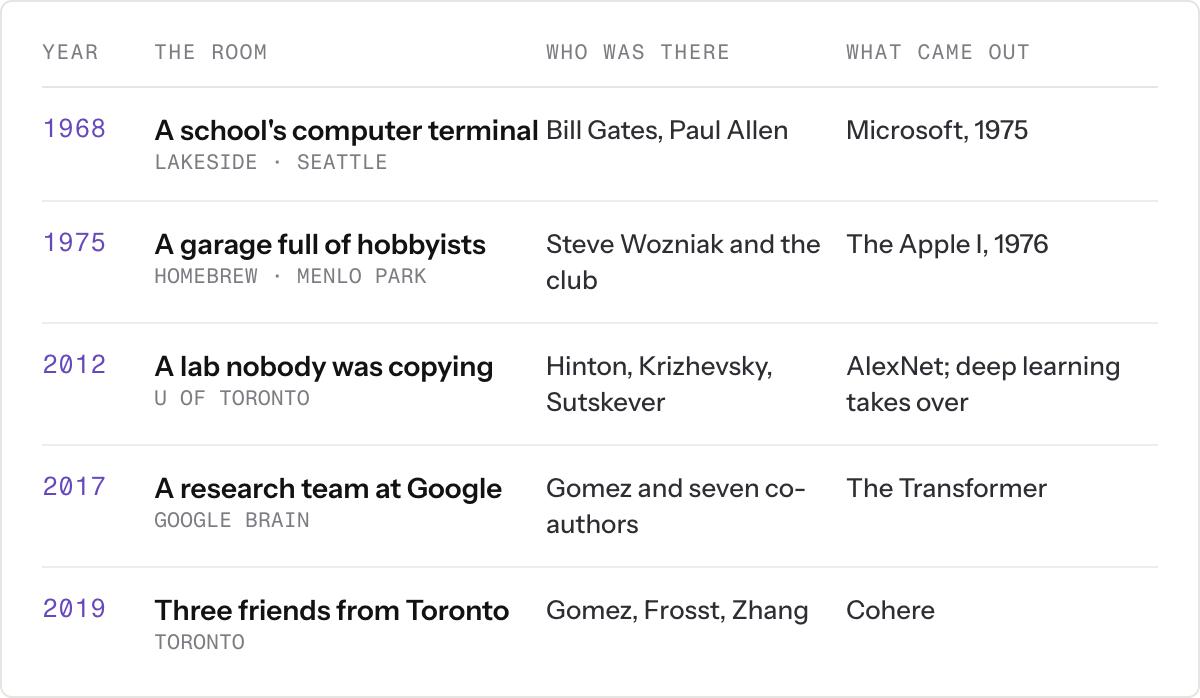
In 1968, Bill Gates was at Lakeside School in Seattle when the Mothers' Club paid for time on a computer terminal, something almost no student then could touch. Gates and Paul Allen got hooked. When their time ran out they found ways to get more than they'd paid for, got banned, and talked their way back in by offering to find the system's bugs.
Gates was obviously gifted. But gifted doesn't explain the trajectory on its own. He landed at a school that happened to have a terminal, next to someone who shared the obsession, with room to spend an unreasonable number of hours in front of it.
Seven years later another room did its work. On March 5, 1975, a group of hobbyists crammed into Gordon French's garage in Menlo Park for the first meeting of the Homebrew Computer Club10. Steve Wozniak was there, and he has said the club is what pushed him to build the Apple I. He showed the design to the room and handed out schematics to anyone who asked.
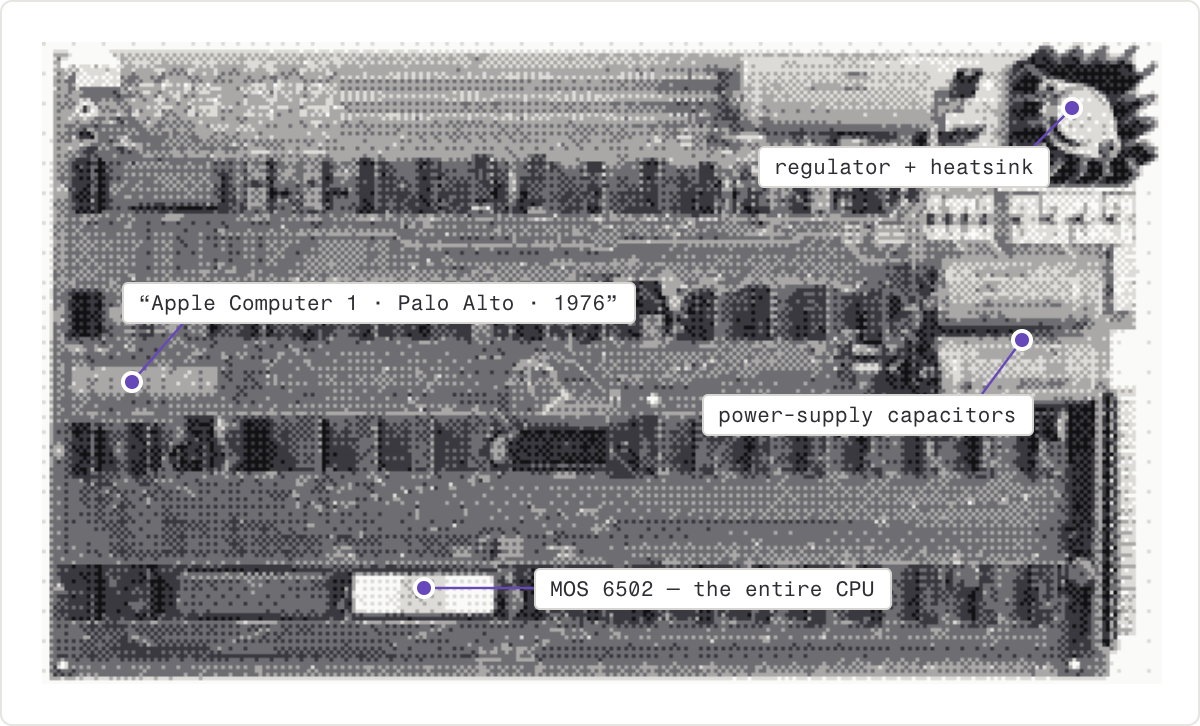
What gets me isn't that Woz found collaborators. It's that he found an audience that understood why the thing mattered before the rest of the world had any idea.
A good room doesn't hand you the answer. Sometimes it just hands you people who already get the question.
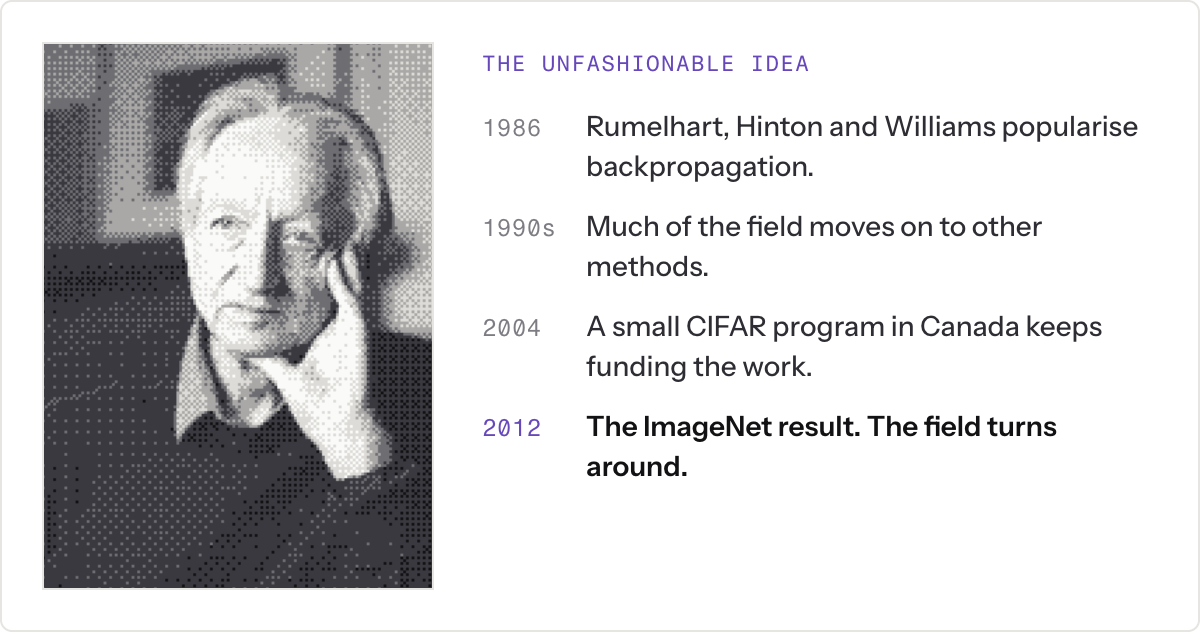
Research runs the same way. Neural networks were unfashionable for years; much of the field had written them off. Geoffrey Hinton and a stubborn handful kept at them anyway, supported by people willing to fund ideas the mainstream had shrugged at. Then in 2012, Hinton, Alex Krizhevsky and Ilya Sutskever published their ImageNet result, and the whole field turned around.
A few years later another cluster formed around Toronto and Google Brain. Aidan Gomez, still a student, was one of the eight authors of the 2017 paper Attention Is All You Need, which introduced the Transformer, the architecture behind every chatbot you've used. In 2019 he founded Cohere in Toronto12 with Nick Frosst and Ivan Zhang.
I did my own stint of AI research at Toronto, so I'll say the obvious caveat: proximity doesn't transfer genius, and a shared address doesn't mean a shared fate. What these rooms do is quieter. They make certain questions visible. They let an idea the rest of the world finds unpromising be taken seriously by a few people who can see where it goes. The most valuable room isn't always the one that agrees with you. It's the one that lets you keep asking.
05 The eight who walked out#
The flip side matters just as much. In 1957, eight young scientists walked out of William Shockley's semiconductor lab in Mountain View, fed up with how he ran it. Two of them were Robert Noyce and Gordon Moore. Together the eight founded Fairchild Semiconductor10, which became the root of Silicon Valley and spun off company after company.
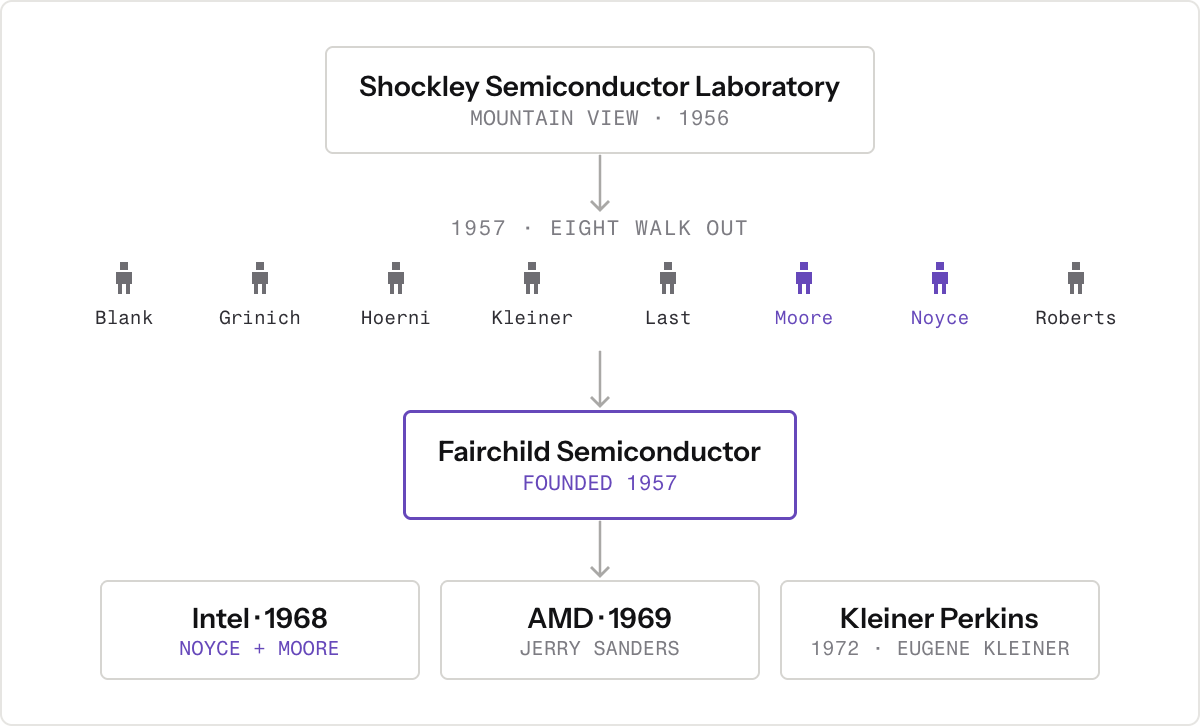
A room can be prestigious, brilliant, and completely wrong for who you're trying to become. Which should make us suspicious of the advice to surround yourself with exceptional people. Exceptional at what? A table of people who've built billion-dollar companies is a rough place to nurse an idea that needs ten quiet years of research. A lab of world-class scientists is a rough place to learn how to sell.
06 Sharper judgment#
It's easy to romanticize this and assume that standing near successful founders simply makes you one. The research says it's stranger than that.
Josh Lerner and Ulrike Malmendier6 studied Harvard MBAs, who are assigned to sections with different numbers of classmates who had already started companies. Students placed with more of those classmates went on to start fewer companies, and the drop came almost entirely from ventures that would have failed. The experienced peers didn't dampen ambition. They sharpened judgment.
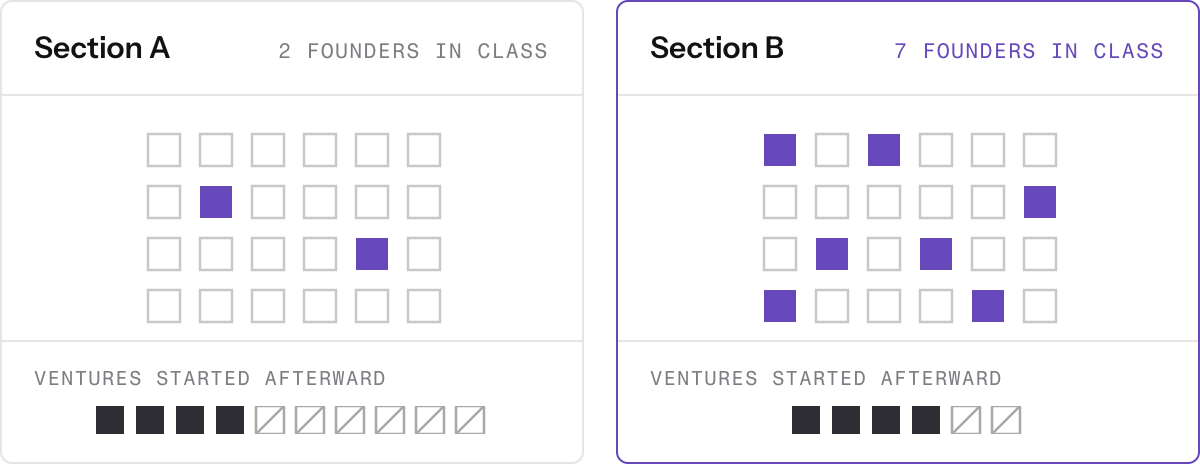

I like this finding because it pushes back on the simple idea that a good environment is one that keeps telling you to aim higher. Sometimes the most valuable thing another founder can tell you is that your idea doesn't make sense.
A strong environment doesn't just get more people to attempt difficult things. It helps them decide which difficult things are worth attempting.
The people around us do more than advise. Pierre Azoulay, Joshua Graff Zivin and Jialan Wang7 looked at what happened when 112 eminent life scientists died suddenly, while still active. Their collaborators' quality-adjusted output fell by roughly 5 to 8 percent, and it stayed down. The loss tracked how close the collaborators had been in ideas, not in miles.
That's a remarkable finding. Part of what we call one person's research ability seems to live in the people they trade ideas with. Noticing a useful connection, asking the important question, catching a weak assumption: these can grow out of repeated contact with other minds.
And yet this creates a problem.
07 When the room thinks alike#
If our environments shape what we think about, what happens when everyone around us starts thinking about the same things? A concentrated founder community can produce extraordinary ambition. It can also produce extraordinary conformity.
Spend enough time around startups and the patterns show. Everyone is interested in the same emerging markets. People borrow the same explanations for why their companies matter. The same words turn up in pitch decks, in conversations, in launch posts.
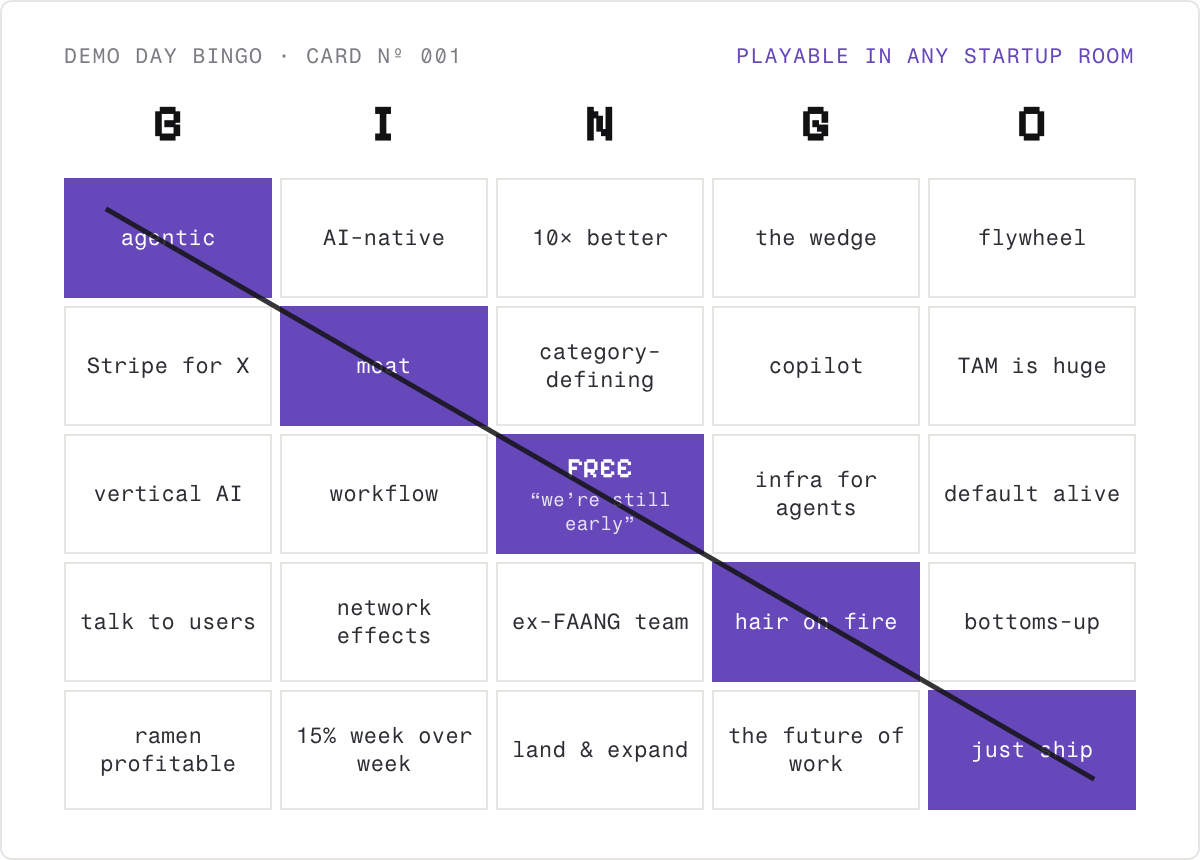
I find myself wondering how many of these beliefs come from independent investigation, and how many are simply absorbed from the surrounding culture.
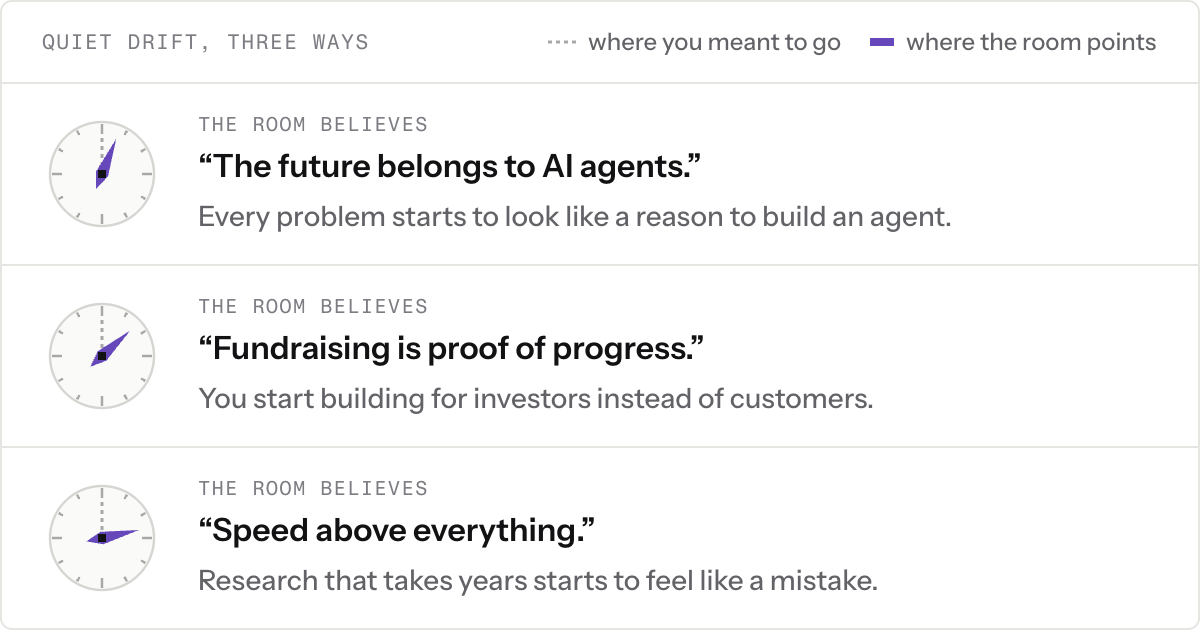
None of these priorities is necessarily wrong. The danger is adopting them without noticing.
08 Colour, or lattice?#
This is where the chameleon starts to look less like a model of adaptation and more like a warning. It's possible to learn the colours of an environment without changing anything underneath.
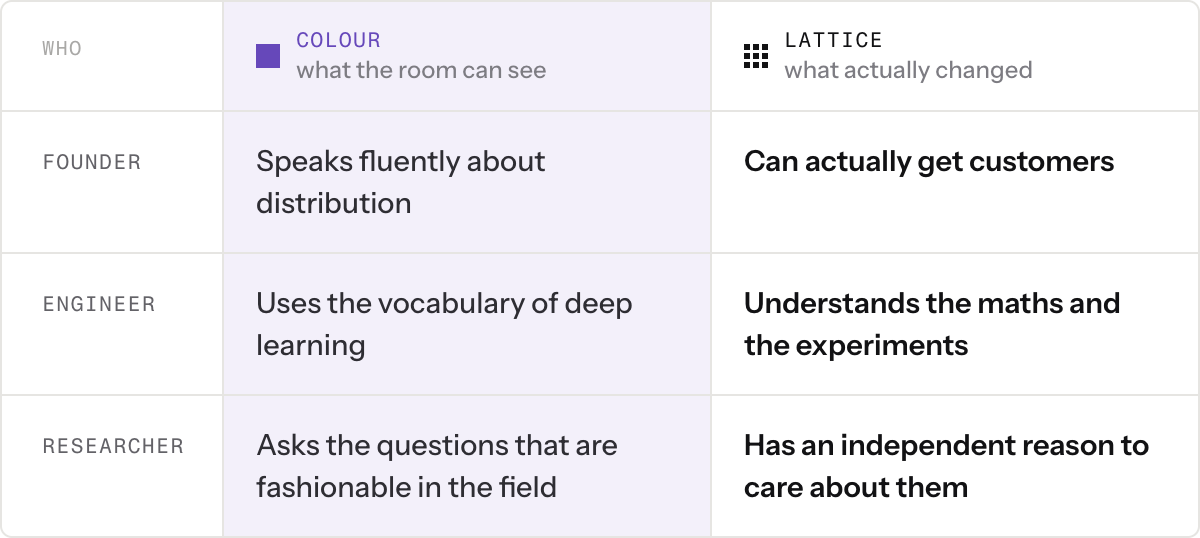
The question is whether the environment has changed your colour, or your lattice.
Have you learned to resemble capable people, or have you actually become more capable? The distinction is uncomfortable, because appearance is much easier to observe than ability. And prestigious environments can make the confusion worse.
This complicates the advice to surround yourself with exceptional people. Exceptional according to whom? Exceptional at what?
A room full of people who have built billion-dollar companies may be a terrible place to develop an idea that needs ten years of research and has no immediate commercial use. A lab full of brilliant scientists may be a poor place to learn how to sell software. Even a community of people you admire can slowly narrow your sense of what counts as worthwhile work.
Brian Uzzi and Jarrett Spiro8 found a related pattern among the people who made Broadway musicals between 1945 and 1989. As their collaboration network grew more interconnected, the shows got better, up to a point. Past it, the relationship reversed. The connections that had carried fresh material between teams became so dense that everyone was working from the same ideas.
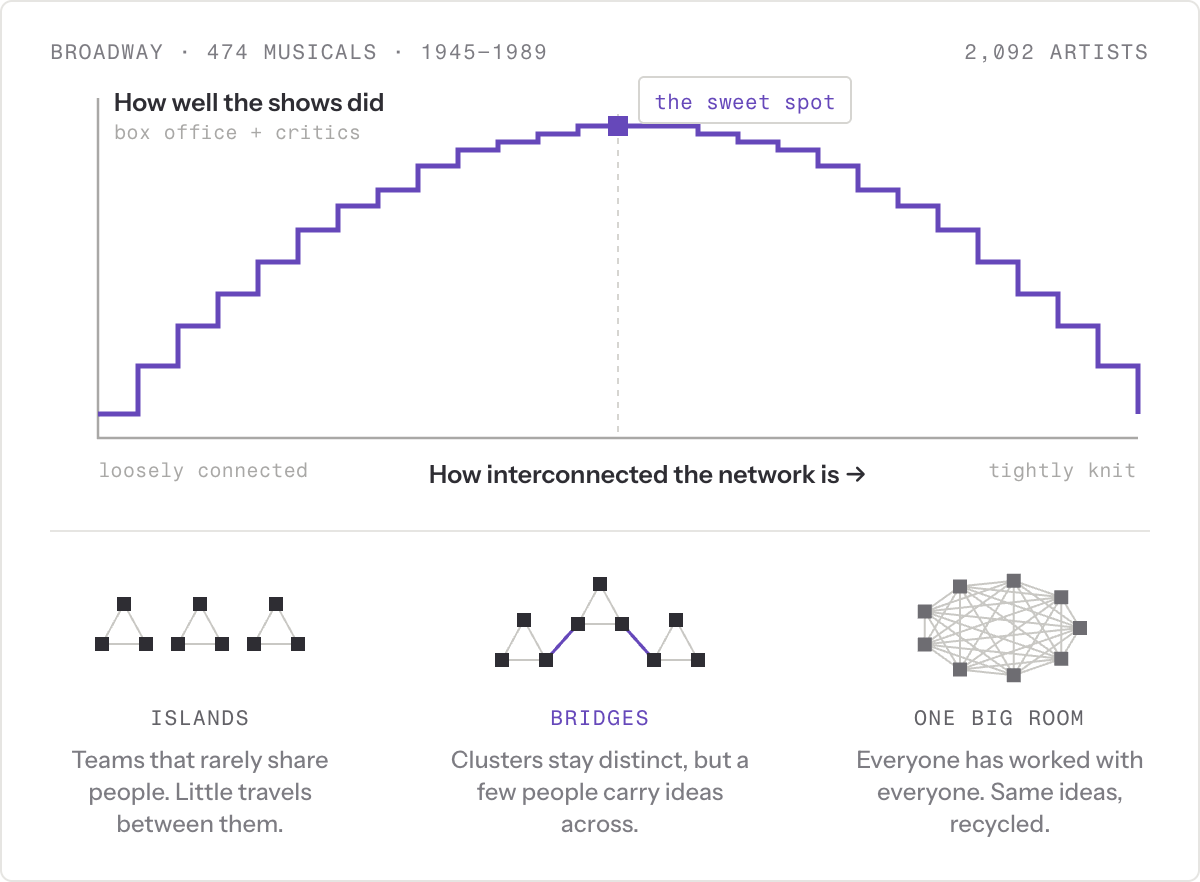
There's something almost paradoxical in that. You need enough proximity to learn from exceptional people, and sometimes enough distance not to become indistinguishable from them. A useful environment exposes you to standards you couldn't develop alone, without dictating every belief you hold.
09 Make it prove itself#
In the 1950s, Solomon Asch9 showed how readily people go along with a group that gives an obviously wrong answer to a simple visual question. The part of his work I find most interesting is what happened when the consensus broke.
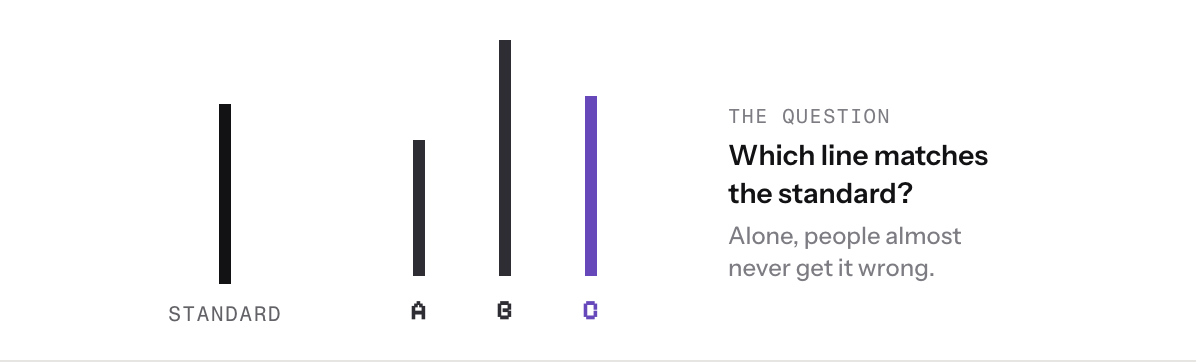
People don't always need a whole alternative community to keep their judgment. Sometimes they need one person willing to say something different.
I think that's one of the most important jobs a cofounder has. Junaid and I grew up on competitions where the whole game was finding the assumption everyone else had missed. You don't get anywhere by accepting a system's description of how it works. You go looking for the place where that description breaks down.
We bring the same rule to Trident. A plausible explanation is cheap, and a model can write a very convincing one that falls apart the moment you try to reproduce it. So the thing we care about is the difference between what merely sounds right and what can be shown, again, under controlled conditions.
Good founder environments should work the same way. An idea shouldn't become more credible because it sounds exciting, or because everyone in the room agrees with it. It should survive contact with people who understand the problem well enough to challenge it.

10 Choosing the forest#
It's worth admitting how much privilege hides in the phrase “choose your environment.” Not everyone can move to San Francisco, study at a particular university, or spend years experimenting with risky ideas.
Bill Gates didn't choose to grow up when computer access was rare and then happen to attend a school that got a terminal. The children in the inventor study didn't choose their parents, their neighbourhoods, or their early exposure to technology. Even the ability to recognise which environment might be useful is partly a product of earlier exposure.
I can look back now and see the influence of CTF competitions, RevisionDojo, research communities and Y Combinator. But that's hindsight. At each stage, I could only weigh the opportunities that were visible to me at the time.
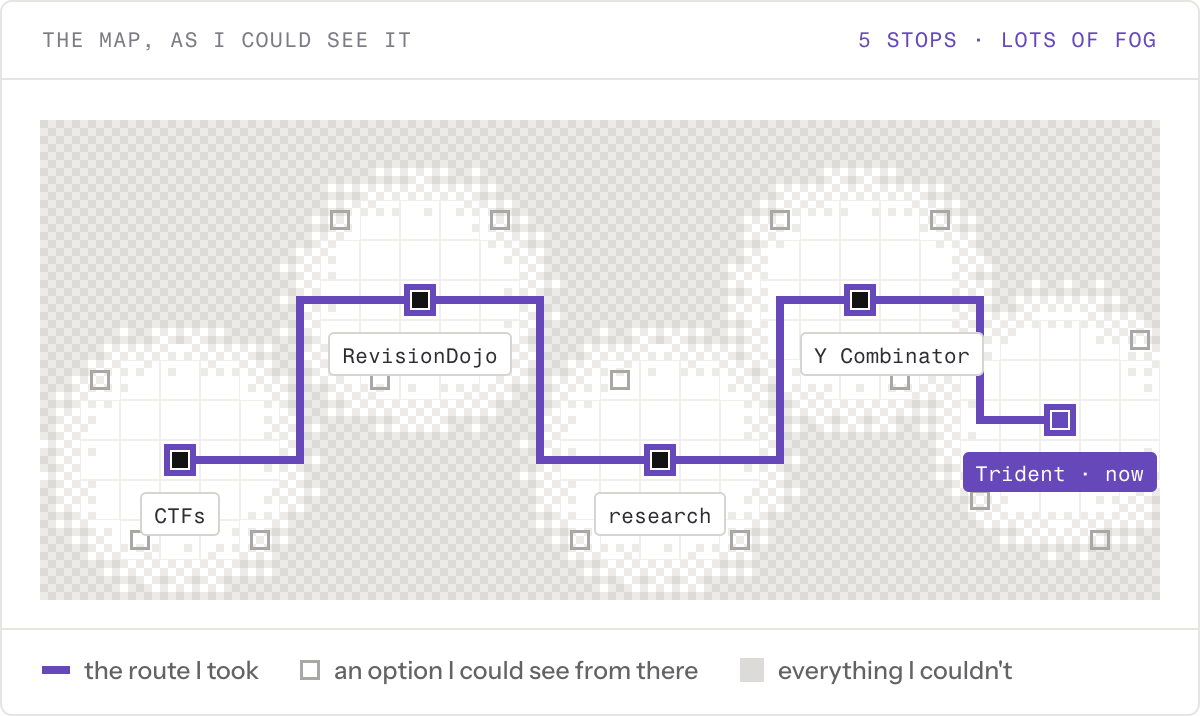
Perhaps that's the deepest part of environmental influence: it shapes not only our choices, but our ability to imagine the alternatives.
Technology makes the question more complicated. The internet lets people take part in intellectual communities without living near their centres. Someone building open-source software in a small town can work with engineers on the other side of the world. Someone without access to an elite institution can read the papers, reproduce the experiments and contribute new findings.
But online environments have their own walls. Algorithms choose which ideas we meet. Networks reward some opinions over others. Communities form around shared assumptions that become hard to question from inside. We may have escaped some geographic limits only to enter environments whose boundaries are harder to see.
As AI makes it easier to write code and explore ideas, I suspect those invisible boundaries will matter more. When building gets cheap, choosing what to build matters differently. The question isn't whether you can build something. It's whether you've developed the judgment to recognise what's worth building, and that judgment depends partly on the people and ideas you're exposed to.
The chameleon analogy has limits, of course. A chameleon's colour changes over seconds or minutes, and its skin drifts back toward where it was once the trigger is gone. Human development accumulates. Five years in a particular intellectual environment leave behind habits of attention, assumptions, relationships and ways of reasoning that don't simply disappear when you leave.
The studies also describe different things. The photonic crystals explain fast changes in a single animal, while the evolutionary work asks why species developed different abilities over generations. Neither is evidence that human talent grows through social exposure the same way.
And unlike the chameleon, we can question the signals around us. We can decide the people we admire are wrong. We can leave. We can go looking for perspectives that contradict what we've learned.
But I think the metaphor survives those objections in a more interesting form. The chameleon's colour is an interaction between what already exists inside the animal and the conditions it meets. Neither side is enough on its own. That doesn't mean human ability works through the same mechanism. It means we should be more careful about treating what people accomplish as if it came entirely from within them.
Individual talent matters. Effort matters. Judgment matters. But so do the people who make particular ambitions imaginable, the communities that reward certain questions, and the environments that teach us which problems deserve our attention. It changes how I want to approach what comes next.
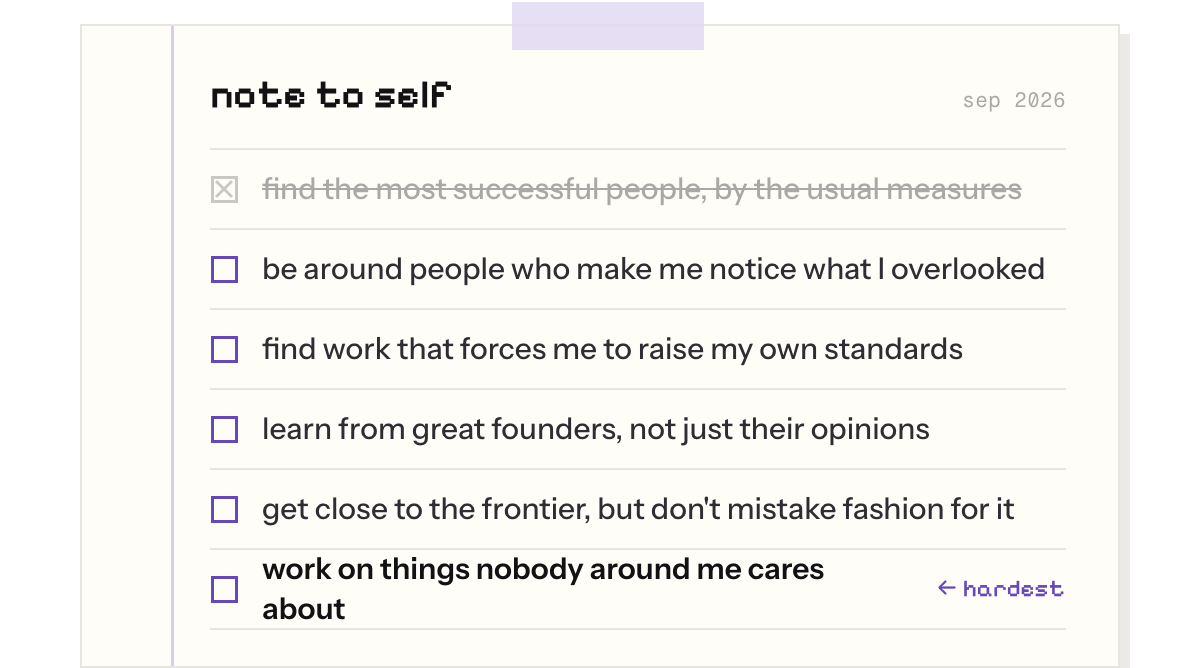
Because the point of finding a better environment shouldn't be to become a copy of the people in it. It should be to become capable of thinking and doing things you couldn't before.
Which brings me back to the chameleon. When it's awake, its colour is regulated by complex responses to the world around it. When it's asleep, something different seems to happen.
As Mark Scherz describes it, the sleeping animal goes pale, and the direct beam of a flashlight can darken the patches of skin it touches. A leaf in the way of the beam leaves a pale outline against the darker skin around it. The pattern is shaped as much by where the light fails to reach as by where it lands.
I think our environments act on us in a similarly uneven way. The people we happened to meet. The university we went to. The first job we took. The friend who introduced us to an idea. The conversations we never had. The books we never found.
We carry the influence of all of it, including the absences. And because the process is gradual, we rarely notice it happening. What once seemed extraordinary becomes ordinary. What once seemed impossible becomes something the people around us attempt every day. We start treating those assumptions as our own understanding of the world.
I can't know how differently my life would have gone if I had never met Junaid, never started doing CTFs, never worked at a startup, or never found the communities that led me to build Trident. Perhaps I'd have ended up somewhere similar. Perhaps I wouldn't even recognise the questions I'm asking today.
What I do know is that the environments I've been in have changed my sense of what's possible. And I suspect the most consequential changes are the ones I'm still too close to see.
A chameleon can't choose its forest. We have more freedom than that, though never as much as we'd like. We can choose some of our collaborators, our communities, our adversaries, and the ideas we give our attention to. We can look for people who expose the weak spots in our thinking instead of reflecting our beliefs back at us. And now and then we can ask whether the changes we see are superficial, or whether something more fundamental has been rearranged.
I used to think the interesting thing about a chameleon was that it could become the colour of whatever surrounded it. Now I think the interesting thing is the opposite. Its most remarkable colours appear when the conditions are right for something already inside it to become visible.
But I keep thinking about that leaf, too. The small patch of skin that stays pale because the light never reached it.
And I wonder how much of what I call my own limitations is really just the outline of something that happened to block the light.
SELECTED RESEARCH AND SOURCES
Biology
- 01Teyssier et al., “Photonic crystals cause active colour change in chameleons.” Nature Communications, 2015.↩www.nature.com/articles/ncomms7368
- 02Stuart-Fox & Moussalli, “Selection for social signalling drives the evolution of chameleon colour change.” PLOS Biology, 2008.↩journals.plos.org/plosbiology/article?id=10.1371/journal.pbio.0060025
- 03Ligon & McGraw, “Chameleons communicate with complex colour changes during contests.” Biology Letters, 2013.doi.org/10.1098/rsbl.2013.0892
- 04Mark D. Scherz, “Can chameleons change colour when they sleep?” The Conversation, 2020.↩theconversation.com/curious-kids-can-chameleons-change-colour-when-they-sleep-135703
Environment and innovation
- 05Bell, Chetty, Jaravel, Petkova & Van Reenen, “Who becomes an inventor in America? The importance of exposure to innovation.” Quarterly Journal of Economics, 2019.↩www.nber.org/papers/w24062
- 06Lerner & Malmendier, “With a little help from my (random) friends.” Review of Financial Studies, 2013.↩www.nber.org/papers/w16918
- 07Azoulay, Graff Zivin & Wang, “Superstar extinction.” Quarterly Journal of Economics, 2010.↩www.nber.org/papers/w14577
- 08Uzzi & Spiro, “Collaboration and creativity: the small world problem.” American Journal of Sociology, 2005.↩doi.org/10.1086/432782
- 09Solomon E. Asch, “Opinions and social pressure.” Scientific American, 1955; and “Studies of independence and conformity.” Psychological Monographs, 1956.↩www.scientificamerican.com/article/opinions-and-social-pressuredoi.org/10.1037/h0093718
Technology and founder history
- 10Computer History Museum, histories of the Homebrew Computer Club and Fairchild Semiconductor.↩computerhistory.org
- 11Paul Graham, “Cities and Ambition.” paulgraham.com, 2008.paulgraham.com/cities.html
- 12University of Toronto News, on the founding of Cohere by U of T alumni.↩www.utoronto.ca/news/startup-launched-u-t-alumni-helps-companies-computers-talk-customers-globe-and-mail
Images
All photographs are from Wikimedia Commons, redrawn here as pencil-grey dithers. Every chart and drawing is built from the cited paper's findings; where a part is drawn rather than measured, its caption says so.
Panther chameleon · Charles J. Sharp, CC BY-SA 4.0commons.wikimedia.org/wiki/File:Panther_chameleon_(Furcifer_pardalis)_male_Nosy_Be.jpg
Apple I · Achim Baqué, CC BY-SA 4.0commons.wikimedia.org/wiki/File:CopsonApple1_2k_cropped.jpg
Robert Noyce · Intel Free Press, CC BY-SA 2.0commons.wikimedia.org/wiki/File:Robert_Noyce_with_Motherboard_1959.png
Geoffrey Hinton · Cmichel67, CC BY-SA 4.0commons.wikimedia.org/wiki/File:Geoffrey_Hinton_in_2026.jpg